
A pest control commission structure rebuild swapped guesswork for predictable weekly pay: capped payouts, job-based checks, and quality deductions.
Pest control commission structure decisions look simple from the outside: pick a percentage, pay it out, move on. In practice, they quietly shape which technicians thrive, whether jobs get rushed or done right, and whether payroll is something an owner dreads every week. A growing pest control company found this out the hard way when it looked closely at how two different technicians were being paid and realized neither approach was actually working.
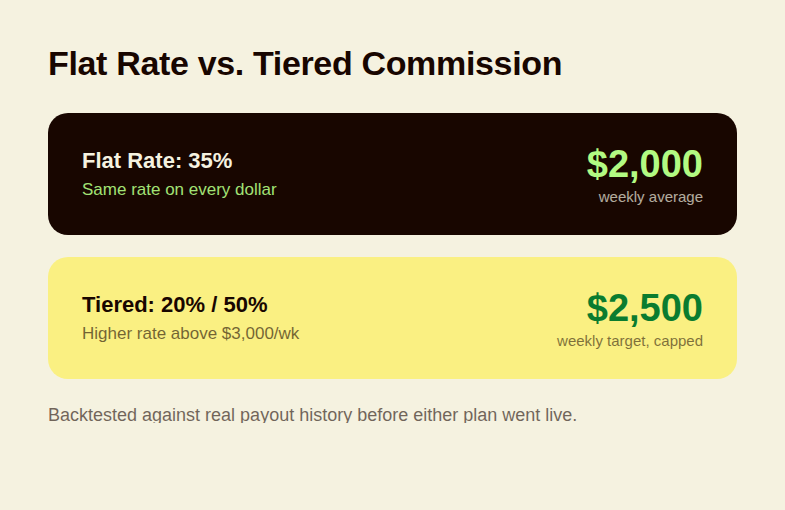
One technician was on a flat 35% commission. It produced a steady $1,700 to $2,400 a week, averaging around $2,000. Predictable, easy to explain, easy to budget. But it had a problem: the percentage didn't move no matter how efficient the technician was, how long a job took, or whether the work held up after the customer walked back inside. A second technician was being considered for a tiered commission instead: 20% on the first $3,000 of weekly revenue, then 50% above that, with a rough target of $2,500 a week. It looked more motivating on paper. Then the owner and their operations partner ran the numbers against a real high-revenue week, and the tiered plan spiked to roughly $4,000 in a single week. That's not a bonus, that's a budgeting problem, and it's exactly the kind of swing that makes an owner start resenting their own commission plan.
Flat Rate vs. Tiered Commission for Pest Control Technicians
Most pest control commission structure debates come down to this exact fork: flat rate or tiered. Both are legitimate, and both have real tradeoffs that only show up once you look at actual payout history instead of a spreadsheet assumption.
A flat rate, like the 35% this company was running, is simple and predictable. Technicians know exactly what they'll earn on every dollar of revenue, and owners know roughly what payroll will look like each week. The downside is that a flat percentage doesn't reward anything beyond raw revenue. A technician who runs an efficient, well-executed route earns the same rate as one who pads hours or lets job quality slide, as long as the revenue number looks the same.
A tiered structure, paying a lower percentage under a revenue threshold and a higher percentage above it, is designed to reward technicians who push past an average week. That's the appeal. The risk is volatility. When this company modeled its proposed 20%/50% tiered plan against a real high-revenue week, instead of a projected average week, the payout jumped to around $4,000, nearly double the $2,500 target. A tiered plan without a cap isn't really a commission structure, it's an open-ended bet on how good any single week happens to be. That's fine for the technician. It's a lot harder for an owner trying to keep labor cost as a predictable percentage of revenue.
The fix wasn't to declare one approach universally better. It was to model both structures against real historical payout data before choosing, and to build in caps so a tiered plan couldn't produce an outlier week that blew up the budget. The company ended up running the flat structure for one technician, targeting roughly $2,000 a week, and a capped tiered structure for the other, targeting roughly $2,500 a week, chosen deliberately instead of guessed at.
Why Job-Based Qualification Matters
Picking a percentage is only half the problem. The other half, and the part most commission plans get wrong, is what counts as a "qualifying" job in the first place.
The original commission calculation at this company paid out on revenue alone. If a job billed $400, the technician earned their commission percentage on that $400, regardless of how long the job actually took. That sounds fine until you think about what it incentivizes: a job sold and estimated at two hours that actually takes four hours still pays full commission, even though it just ate twice the labor cost it was supposed to. The technician isn't necessarily doing anything wrong, but the pay structure has no way to tell the difference between an efficient job and one that quietly blew through its budget.
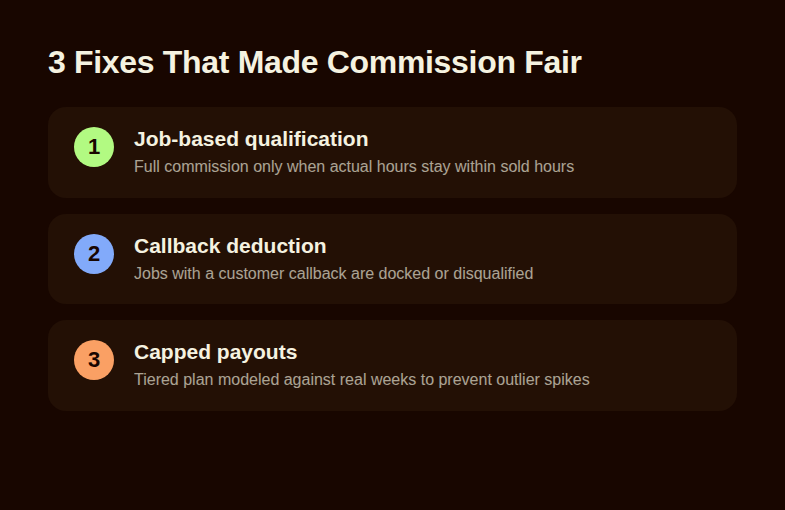
The fix was job-based qualification. The company added a "sold hours" custom field to track the estimated time for each job, then compared it against actual time worked. Commission is only paid at full value when the job's actual hours fall within its sold hours. A job that runs over budget no longer inflates the payout the same way a job that came in on time does. This one change turned the commission structure from "pay on revenue" into "pay on revenue earned efficiently," which is a very different incentive for a technician deciding how carefully to work a route.
How to Stop Paying Full Commission on Callback Jobs
The second structural gap was quality. Before the rebuild, there was no way to dock or disqualify revenue from a job that generated a callback, meaning the customer had to request a return visit to fix something that wasn't handled correctly the first time. A technician could get a complaint, send someone back out to redo the work, and still collect full commission on the original job as if nothing had gone wrong.
That's a real problem for any company trying to build a pay structure that actually rewards quality work instead of just revenue booked. The fix here was a callback field tied directly into the commission calculation. When a job is flagged with a callback, it can either take a fixed deduction (the company used $50 as its example) or be disqualified from commission entirely, depending on how serious the issue was. Either way, the technician's pay now reflects whether the job actually held up, not just whether it got invoiced.
This is the piece that a lot of pest control commission structures skip entirely, because it's more work to set up than a straight percentage. But without it, commission pay and job quality are two completely disconnected systems, and technicians will always optimize for whichever one actually affects their paycheck.
Profit sharing
made simple.
Give your team a stake in the company’s success. ShareWillow helps you create and manage profit-sharing programs that motivate employees and drive business results.
Building a Pest Control Commission Structure You Can Actually Budget For
The real shift at this company wasn't picking flat over tiered, or tiered over flat. It was refusing to pick either one based on a guess. Instead of modeling a commission structure on assumptions about an average week, the owner and their operations partner backtested both the flat and tiered options against real historical payout data, which is how they caught the tiered plan's $4,000 outlier week before it ever hit a real paycheck.
That backtesting habit matters just as much as the percentages themselves. A commission plan that looks reasonable in a spreadsheet can behave very differently once it's run against an actual busy week, an actual slow week, and an actual technician who works faster than the model assumed. Modeling against real data, then adding caps to prevent runaway payouts, is what turned this into a plan the company could actually forecast against instead of one it had to hope stayed within budget.
The result was two technicians on two different, deliberately chosen structures: one flat at 35%, averaging close to $2,000 a week, and one tiered with caps, targeting closer to $2,500 a week. Both numbers are now something the owner can actually plan payroll around, and both are backed by a calculation that checks job efficiency and job quality before it checks the invoice total.
Commission is only one lever in a broader pay strategy. Home service companies solving similar problems around attendance and punctuality have had success with a compliant attendance-based bonus plan for pest control technicians, and companies structuring performance pay more broadly often start from a general tiered bonus structure framework before adapting it to their own numbers. Commission, quality pay, and attendance incentives work best when they're designed together instead of bolted on one at a time. You can see how ShareWillow's plan-building and payout tracking tools handle job-based qualification, callback deductions, and tiered caps automatically, without needing a spreadsheet rebuilt every quarter.
What's a good commission rate for pest control technicians?
There's no single right number, but flat rates in the 30% to 40% range are common for pest control technicians handling both sales and service, while tiered structures typically start lower (around 15% to 20%) below a revenue threshold and climb higher (40% to 50%) above it. The right rate depends less on the percentage itself and more on whether it's tied to job-based qualification and quality checks, so the payout reflects real performance rather than just revenue booked.
Should pest control techs be paid flat or tiered commission?
It depends on what you're trying to reward. Flat commission is simpler and more predictable for both the technician and the owner, which makes it a solid default. Tiered commission can push higher performers to do more, but it needs a cap and should be backtested against real historical payout data first, since an uncapped tiered plan can spike to unpredictable levels in a single strong week.
How do you stop commission pay from encouraging rushed or low-quality work?
Add two checks to the commission calculation itself: job-based qualification, which only pays full commission when a job's actual hours stay within its sold or estimated hours, and a callback deduction or disqualification, which reduces or removes commission on jobs that generated a customer complaint requiring a return visit. Together they make commission reflect efficient, correctly done work instead of just revenue collected.
Related reading
- The Pest Control Company That Stopped Paying Techs to "Milk the Clock" and Built a Compliant Bonus Plan Instead
- How a Pest Control Company Designed Pay That Rewards Quality, Not Just Speed
- How to Maximize Employee Performance with Tiered Bonus Structures
- 9 Bonus Structure Examples Employees and Employers Love
Conclusion
Predictable pay, better quality, and a commission plan the owner can finally budget around.
Create incentives
that
drive results
You shouldn't need complex equity plans to align your team. ShareWillow makes it simple to create transparent profit-sharing programs that motivate employees and grow your business.

Incentive plans to help
small businesses thrive.
.png)
"I was able to leverage the knowledge of the ShareWillow team to learn how other companies were designing their bonus plans. The template was extremely helpful."

Brian Tustin
Owner, First Rate Movers
